
Works through failure
The core workflow must remain useful during an internet outage and synchronize safely when connectivity returns.
UPCOMING HACKATHON · EARLY 2027
Build for when everything else fails.
A 48-hour sprint to build practical technology for disaster response and resilience in Nepal.
Registration opening soon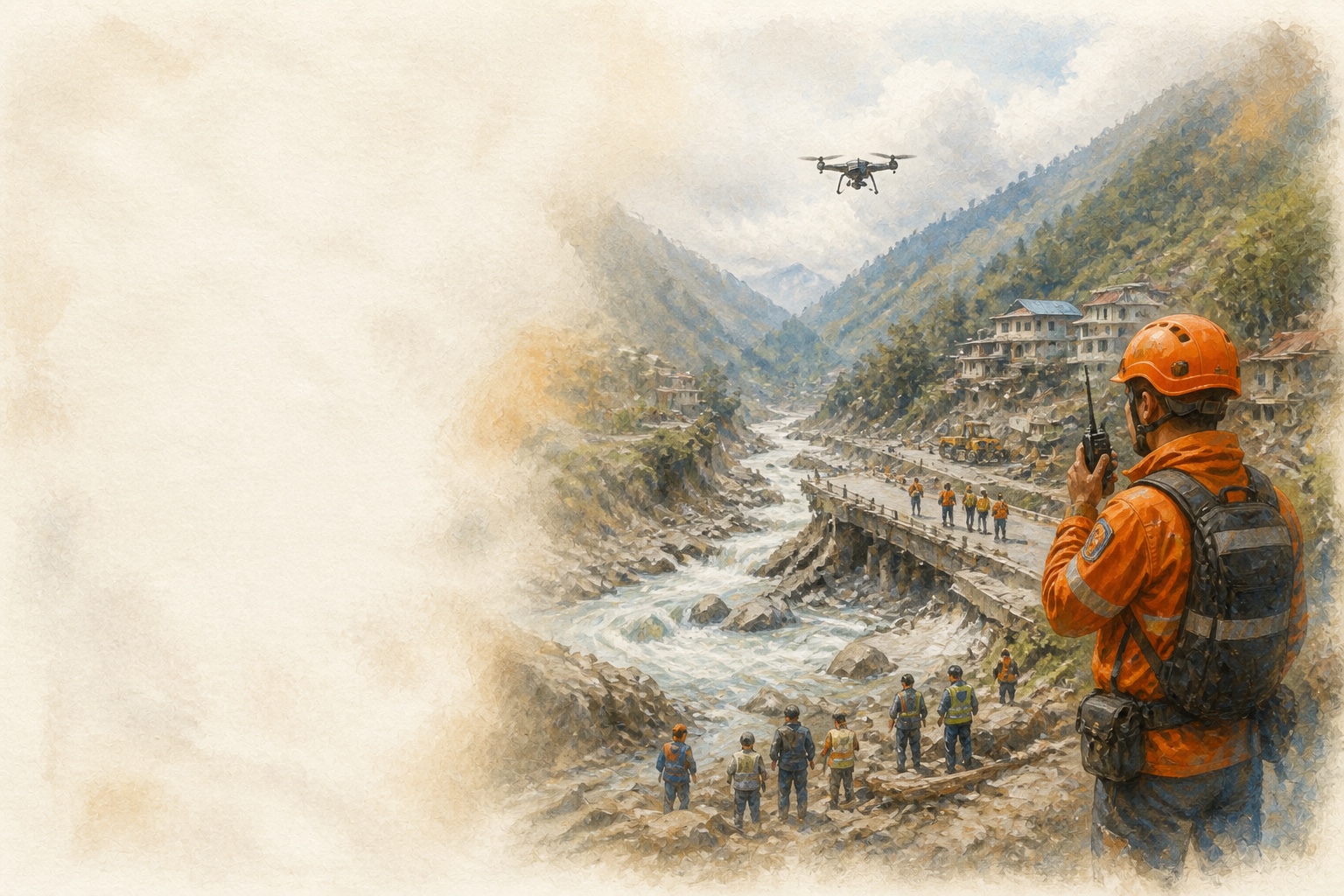
THE CHALLENGE
Design for the first 72 hours after a severe flood or landslide. Roads are blocked, power is unreliable, and responders have incomplete information. Your challenge: make one response workflow faster, safer, or more reliable.
Choose a real user, a specific failure scenario, and an outcome you can demonstrate.
CHOOSE YOUR CHALLENGE
Keep affected communities and responders connected when mobile networks and internet access fail.
Possible builds: Bluetooth or Wi-Fi Direct mesh messaging, LoRa relays, store-and-forward alerts, offline family check-ins.
Help field teams locate, identify and prioritize missing or trapped people without creating duplicate reports.
Possible builds: Drone or thermal review, acoustic detection, last-known-location tools, deduplicated missing-person registries.
Build a shared, time-stamped view of damaged roads, settlements, hazards, shelters and response activity.
Possible builds: Offline-first maps, crowdsourced damage reports, satellite-change review, verified field observations.
Turn weather, river, terrain and community observations into understandable warnings people can act on.
Possible builds: River-threshold alerts, landslide-risk indicators, last-mile warning delivery, alert confidence levels.
Find safe ways to reach isolated people when bridges fail, roads are blocked and conditions change quickly.
Possible builds: Dynamic route planning, foot and air access maps, evacuation sequencing, safe rendezvous coordination.
Support triage, referrals and continuity of care in low-power, low-connectivity field conditions.
Possible builds: Offline triage records, referral coordination, medication availability, responder decision-support checklists.
Get water, food, medicine, shelter materials and equipment to the right place without gaps or duplication.
Possible builds: Needs-to-inventory matching, last-mile dispatch, delivery proof, equitable allocation and stock forecasting.
Give agencies and local responders one actionable operating picture while keeping decisions accountable.
Possible builds: Incident dashboards, task handoffs, report verification, source and timestamp tracking, rumor control.
Match displaced people with safe, accessible shelter and help separated families reconnect securely.
Possible builds: Capacity and accessibility tracking, privacy-aware registration, reunification workflows, protection referrals.
Move from immediate response to transparent assessment, assistance and safer rebuilding.
Possible builds: Rapid building surveys, loss documentation, aid case tracking, resilient reconstruction and livelihood tools.
THE EXPERIENCE
Two short orientation sessions introduce Nepal's disaster-response structure, lived community needs, available datasets, safety, privacy and challenge-track mentors.
Teams validate a specific user, location and failure scenario, map the current workflow and define one measurable response outcome.
Teams prototype with domain and technical mentor rounds, then run an outage test, incomplete-data test and field-usability review.
Teams close critical gaps, document risks and handoff needs, and prepare a live scenario-based demonstration for judges.
Selected teams enter a structured review with potential users. Promising prototypes receive technical hardening, testing and partner-pilot support.
THE DETAILS
The core workflow must remain useful during an internet outage and synchronize safely when connectivity returns.
Design for remote settlements, blocked roads, limited power, low-cost devices and handoffs between local and national responders.
A first-time user should understand the critical action quickly. Support Nepali and English where language affects safety.
Collect the minimum sensitive data, explain access and retention, and never expose victims through public-by-default systems.
Every report, prediction or AI output needs a source, timestamp and confidence state so responders can judge its reliability.
Use open formats where practical and document how a municipality, responder or community group could operate the prototype.
A specific, evidenced need in the disaster workflow—not a generic app with a disaster label.
Useful under connectivity, power, device and data constraints, with graceful failure behavior.
Clear under pressure and considerate of language, disability, age, geography and digital literacy.
A working core flow, credible architecture, sensible tradeoffs and a demonstrable prototype.
A measurable response improvement and a realistic path to ownership, deployment and maintenance.
Responsible data handling, transparent uncertainty and protection from harmful misuse.
Shape real workflows, mentor teams and test whether prototypes make sense in the field.
Prepare safe, documented weather, mapping, infrastructure or simulated incident datasets.
Provide mapping, communications, cloud, edge, device or compute tools—with offline alternatives.
Recruit multidisciplinary teams, host preparation sessions and support applied research.
Keep lived experience, accessibility and local response practices inside the design process.
Support event delivery, participant access, prizes and the harder work of post-event pilots.
Selected teams enter a field review with potential users. Promising prototypes receive a structured pathway toward technical testing and partner pilots. Finalists document their failure-mode tests, operational handoff, and lessons for future builders.
YOUR NEXT BUILD
Bring your curiosity, your skills, and an interest in making disaster response more resilient. Register your interest in Lifeline Nepal · 2027 to hear about next steps.
The event is planned for early 2027. Exact dates and venue details will be announced. Registering interest does not confirm a place.
Have a question? Get in touchBE PART OF LIFELINE NEPAL